


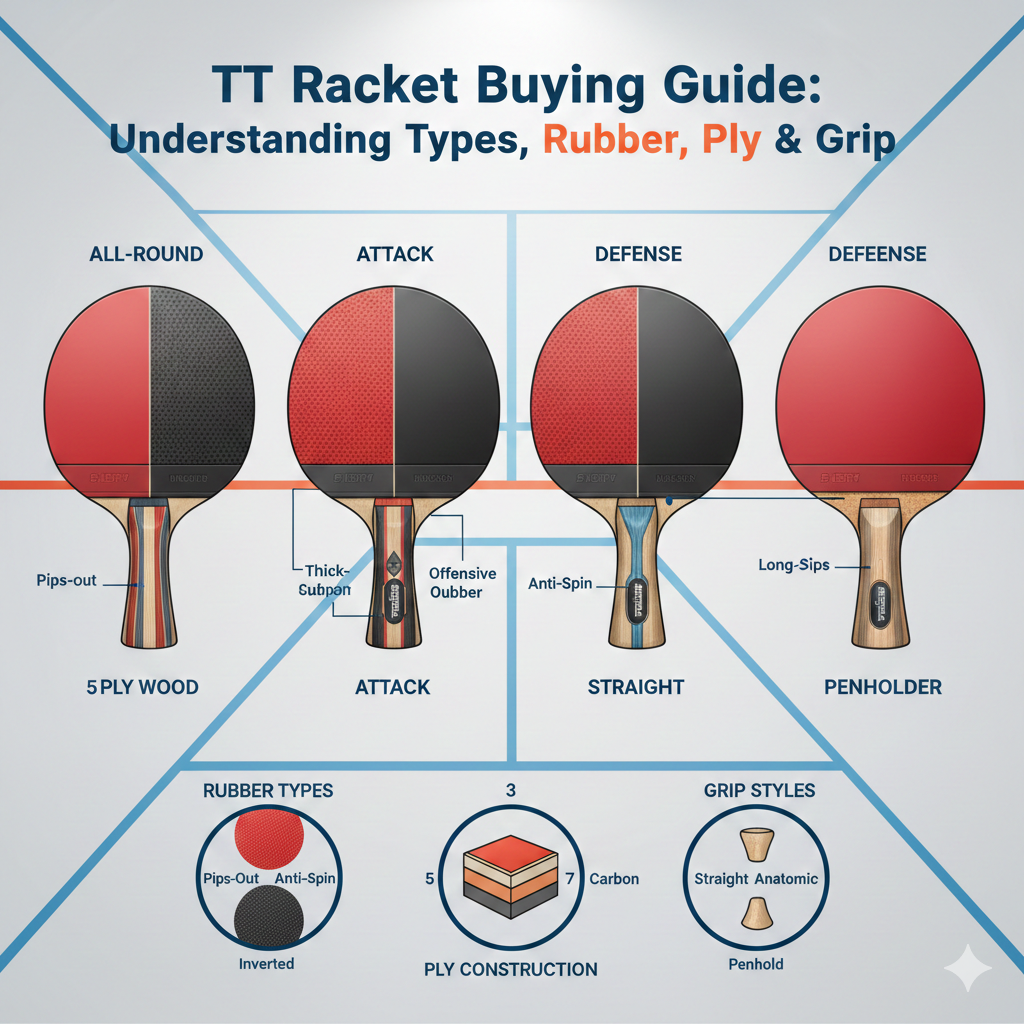
TT Racket Buying Guide: Understanding Types, Rubber, Ply & Grip
Posted on: 04 Dec, 2025
A table tennis racket (TT racket or TT bat) might look simple, but its construction plays a huge role in your performance—whether it’s spin, control, speed, or smash power. If you’re confused about which TT racket to buy, this guide will help you understand every important part: types, blade ply, rubber, sponge thickness, grip, and playing style suitability.
1. Types of TT Rackets
✔ Beginner Rackets
- Lightweight
- Good control
- Ideal for kids, casual players, and new learners
- Helps develop consistent strokes
✔ Intermediate Rackets
- Balanced combination of speed + spin
- Slightly thicker sponges
- Perfect for players improving their game
✔ Professional/Advanced Rackets
- High-speed blades
- Premium rubber (tacky/grippy)
- Designed for offensive play, looping, aggressive shots
Choose based on your playing style, not just price.
2. Understanding Ply (Blade Layers)
The blade is made from layers of wood or carbon called ply.
✔ 5-Ply Blades
- More control
- Best for defensive or all-round players
✔ 7-Ply Blades
- Faster shots
- Suitable for offensive players
✔ Carbon Blades
- Very fast
- Enlarged sweet spot
- Used by advanced players for maximum power
Rule:
- More ply = more speed
- Fewer ply = more control
3. Rubber Types & Their Impact
TT bat rubber affects spin, control, and speed more than any other part.
✔ Smooth (Inverted) Rubber
- Highest spin generation
- Best for modern players
- Used in professional rackets
✔ Pimpled Rubber (Pips-Out)
- Good for speed and flat hits
- Less sensitive to opponent spin
- Ideal for attackers
✔ Long Pips Rubber
- Used for tricky defensive play
- Can reverse spin
- Hard to master but very effective
Choose rubber depending on whether you want spin-heavy, speed-focused, or defensive gameplay.
4. Sponge Thickness Matters
The sponge under the rubber controls the racket’s speed.
- 1.5 mm or less: More control, less speed (good for beginners)
- 1.8–2.0 mm: Balanced spin and speed (intermediate level)
- 2.2 mm: Maximum speed and aggression (advanced/offensive players)
5. Grip Types (Handle Shapes)
✔ Flared (FL)
- Widest at the end
- Great grip
- Most popular among players
✔ Straight (ST)
- Uniform handle
- Allows quick switching between forehand & backhand
✔ Anatomic (AN)
- Slight curve fits natural hand shape
- Very comfortable for long matches
Choose the one that feels natural when you hold it.
6. Which Racket Should You Choose? (Based on Playing Style)
Defensive Player
- 5-ply blade
- Thin sponge
- Inverted or long pips
All-Round Player
- 5 or 7 ply
- Medium sponge
- Standard inverted rubber
Offensive Player
- Carbon blade
- Thick sponge
- High-tension inverted rubber
7. Why a Good TT Racket Makes a Big Difference
A quality racket helps you:
- Generate higher spin
- Improve control and precision
- Switch quickly between shots
- Get faster and more powerful smashes
- Play consistently at any level
If you're upgrading, choose a racket designed with:
- Good grip
- Stable ply structure
- High-quality rubber
- Balanced weight
TT rackets from trusted brands like Koxtons offer durability, excellent rubber quality, and tournament-ready performance.
Conclusion
Understanding your racket’s type, ply, rubber, sponge, and grip helps you pick the perfect TT bat that matches your style. Whether you’re a beginner or an aspiring professional, the right racket will elevate your game and help you play more confidently.
Recent Posts
-
 KX-10008 Table Tennis Table (Club Series) 30 Mar, 2026
 -
-

-


Comments
No comment yet.